
You just received the results of a routine blood test. As you review the results and compare them with the reference values, you notice a slight elevation of SGPT levels. A quick internet search reveals something about possible liver damage, and you start to worry. But what could this elevation really mean? What information do SGPT levels provide in medical care? When is its elevation really a cause for concern? Go on reading to learn more about how two liver enzymes, SGOT and SGPT, are evaluated and which diseases they are linked to.
SGOT and SGPT functions
SGOT and SGPT belong to a group of enzymes called aminotransferases or transaminases, because of their ability to transfer amino groups. When cells are injured by disease or inflammation, these enzymes are released into the circulation. There, they can be detected with a simple blood test and can assist the physician in making a diagnosis.
SGOT (AST)
SGOT, short for Serum Glutamic Oxaloacetic Transaminase, is an enzyme involved in amino acid metabolism. It is also called AST (Aspartate Aminotransferase). This enzyme catalyzes the transfer of an amino group from aspartate to a-ketoglutarate, resulting in the production of glutamate and oxaloacetate. These products play important roles in metabolic pathways and energy production.
SGPT (ALT)
SGPT, short for Serum Glutamate Pyruvate Transaminase, is another enzyme with similar catalytic functions. It is also called ALT (Alanine Aminotransferase). It mediates the transfer of an amino group from alanine to a-ketoglutarate, resulting in the production of glutamate and pyruvate. In turn, these products take part in energy production processes.
SGOT and SGPT elevation
SGOT and SGPT are widely known as liver enzymes that help identify liver damage, since they are found in hepatocytes (liver cells).
SGOT is present not only in liver cells, but also in other organs or tissues, such as the heart, muscles, and kidneys. Normally, the concentration of this enzyme in a blood sample is low. However, in the case of tissue damage, SGOT is released into the circulation, and its blood levels rise. This is indicative of tissue damage. The degree of SGOT release into the bloodstream, as well as the duration of the elevation, depends on the type of damaged tissue and the extent of the injury.
In contrast, SGPT is a liver-specific enzyme, found predominantly within liver cells. When there is a liver injury, SGPT is released into the bloodstream, and its levels may remain elevated longer than those of SGOT. The degree of elevation depends on the cause of the injury, since different disorders have different effects on SGPT release.
Diagnostic criteria
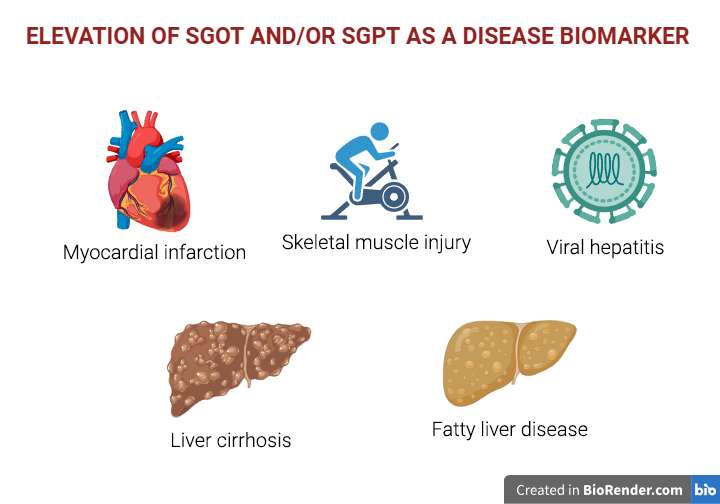
As mentioned earlier, SGOT is not a liver-specific biomarker. Increased SGOT levels can occur due to either liver injury or damage to other organs. Liver-related causes of increased SGOT include disorders such as viral hepatitis and alcoholic or non-alcoholic liver disease. Common non-liver-related disorders that cause SGOT elevation include myocardial infarction, hemolysis, or skeletal muscle injury from strenuous exercise. Because SGOT lacks specificity, measuring its levels alone is not enough. Additional tests are required for a differential diagnosis. Typically, if the injury is minor, there is a transient increase in SGOT levels. In cases of extended damage, SGOT levels can remain high for a few days. In cases of alcoholic hepatitis or heart attack, the SGOT serum levels can become 8 times higher than normal.
On the contrary, SGPT is a liver disease-specific marker. Its levels can rise in a number of liver injuries, such as viral hepatitis, non alcoholic fatty liver disease, non-alcoholic steatohepatitis, alcoholic liver disease, liver cirrhosis, or drug-induced toxicity. However, in order to differentiate between these conditions, additional patient data and diagnostic tests are needed.
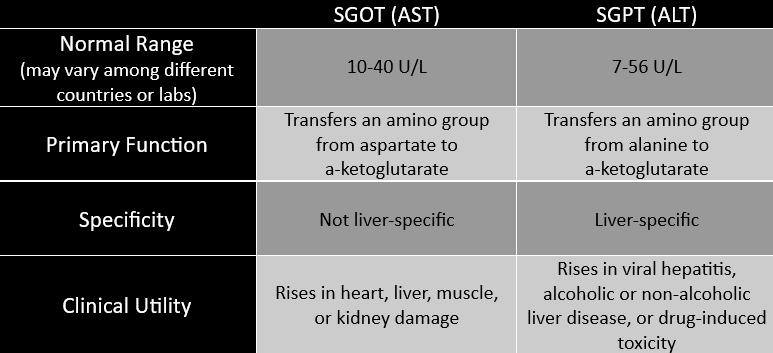
The relative levels of these two enzymes provide useful information, as well. For example, when the SGOT/SGPT ratio is lower than 1, this points towards liver damage caused by viral hepatitis. On the other hand, when the SGOT/SGPT ratio is higher than 2, this is indicative of alcoholic liver disease.

Overall, SGOT and SGPT levels provide valuable information with a simple blood test. However, clinicians do not rely solely on these tests. Rather, they consider a combination of data regarding medical history, risk factors, additional test results, and the patient’s overall clinical presentation in order to determine the underlying cause of the SGOT and/or SGPT elevation.
Source:
https://pmc.ncbi.nlm.nih.gov/articles/PMC5318690/pdf/EXCLI-15-817.pdf